A full map of Arab-African historical relationships — the trans-Saharan trade, the Arab slave trade, Islam in Africa, colonial-era Arab-African politics, and contemporary connections.
I. The Trans-Saharan Trade: The First Connection
The Arab world and sub-Saharan Africa were connected long before European colonialism — through the trans-Saharan trade routes that crossed the Sahara Desert from the Mediterranean coast to the West African savannah. These routes, operational from at least the 3rd century CE and reaching their peak between the 8th and 16th centuries, carried gold, salt, ivory, kola nuts, and enslaved people northward, and carried cloth, horses, copper, and luxury goods southward. The great West African empires — Ghana, Mali, Songhai — derived much of their wealth from controlling these routes and taxing the trade that flowed along them.
The trans-Saharan trade brought Islam to West Africa — not primarily through conquest (as in North Africa) but through the commercial networks of Arab and Berber merchants who settled in West African trading cities and whose religion spread gradually into the local population. By the 11th century, the rulers of Ghana had converted to Islam; by the 13th century, the Mali Empire under Mansa Musa was a Muslim state whose ruler's famous pilgrimage to Mecca in 1324–1325 — during which he distributed so much gold that he temporarily depressed the price of gold across the Mediterranean world — made West Africa visible to the Arab and European worlds as a source of extraordinary wealth.
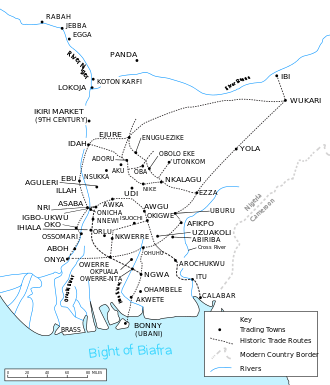
The Igbo were not directly part of the trans-Saharan trade network — their forest homeland south of the Niger River was outside the savannah zone through which the trans-Saharan routes ran. But the trade and the Islamic expansion it carried shaped the political landscape of West Africa within which the Igbo existed: creating the Hausa-Fulani states to the north of Igboland that would eventually become the dominant partner in the colonial amalgamation that produced Nigeria.
II. The Arab Slave Trade
The Arab slave trade in sub-Saharan Africa predated the Atlantic trade by centuries and outlasted it by decades. Arab and Swahili traders operating from the East African coast — Zanzibar, Kilwa, Mombasa — and across the Sahara enslaved and transported millions of Africans to North Africa, the Arabian Peninsula, Persia, and India over a period spanning roughly the 7th to the 20th centuries. Estimates of the total number of Africans enslaved in the Arab trade range from 10 to 18 million — comparable in scale to the Atlantic trade.
The Arab slave trade affected different African regions than the Atlantic trade. East Africa and the Sudan were the primary sources; West Africa was primarily affected through the trans-Saharan routes. The Igbo, as a forest people of southeastern Nigeria, were not directly targeted by the Arab trade in the way that peoples of the East African interior were. But the trade is part of the broader context of African experience of enslavement that includes the Atlantic trade, and its historical reality is relevant to any honest accounting of Arab-African historical relations.
The Arab slave trade is a subject of significant political sensitivity in contemporary African-Arab relations. Arab governments and scholars have been generally reluctant to acknowledge its scale or its moral equivalence to the Atlantic trade. African scholars and activists have increasingly insisted on this acknowledgement as a precondition for honest Arab-African partnership.
III. Islam in Igboland
Islam reached Igboland primarily through the colonial period and its aftermath — not through the trans-Saharan trade (which bypassed the forest zone) but through the integration of Igboland into the Nigerian colonial state, which brought Igbo people into sustained contact with Hausa-Fulani Muslims in the north. The Muslim Igbo population — concentrated in communities that had significant contact with northern Nigeria through trade, labour migration, or the colonial administrative system — has always been a minority within a society where Christianity (introduced by the Church Missionary Society and the Roman Catholic Church from the 1840s onward) became the dominant religion of the educated and commercially active Igbo population.
The relationship between Igbo Christians and Hausa-Fulani Muslims is the central ethnic-religious fault line of Nigerian politics. The pogroms of 1966 — in which Igbo living in predominantly Muslim northern Nigeria were massacred — had an explicitly religious dimension: the victims were identified partly by their Christianity as well as by their Igbo ethnicity. The contemporary Nigerian conflict between the federal government (historically dominated by northern Muslim interests) and the Igbo self-determination movement is thus simultaneously ethnic and religious in its dimensions.
IV. Contemporary Arab-African Relations
Contemporary relations between the Arab world and Africa are shaped by several overlapping dynamics: oil wealth and investment (Arab sovereign wealth funds and development banks are significant investors in African infrastructure); labour migration (millions of African workers, including many Nigerians, work in Gulf states under conditions that human rights organisations have repeatedly described as exploitative); religious influence (Saudi Arabia's export of Wahhabi Islam through mosque construction, scholarship funding, and media has significantly shaped African Islam in directions that have sometimes increased social tension); and political solidarity (the Arab League and the African Union have formal relationships but significant divergences of interest on questions including the Western Sahara, Sudan, and Libya).
For the Igbo specifically, the Arab world is relevant primarily through two channels: the Gulf states as destinations for Nigerian labour migration (including Igbo migrants, though the Igbo have historically been more oriented toward Europe and North America as migration destinations); and the role of Arab (particularly Libyan and Saudi) funding in supporting Islamist movements in northern Nigeria, which has contributed to the security environment that affects all Nigerians including the Igbo.