
The Aro — the Igbo trading people centred on Arochukwu, whose commercial network connected Igboland to the Atlantic slave trade and whose oracle, the Ibini Ukpabi, exercised authority across southeastern Nigeria.
Who the Aro Were
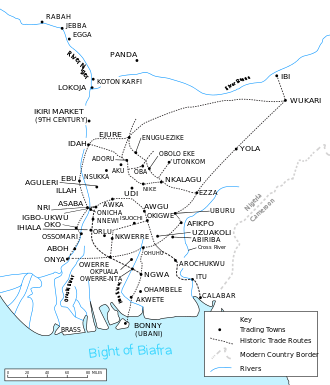
The Aro are an Igbo subgroup centred on Arochukwu (also written Aro Chukwu — "voice of God") in present-day Abia State, on the southeastern edge of Igboland near the Cross River. Their origin tradition describes them as a fusion of three peoples: the Igbo of Ibibio origin, the Ibibio, and the Akpa — a fusion that gave them cultural connections across the southeastern Nigerian zone and commercial networks that extended in multiple directions simultaneously.
From their base at Arochukwu, the Aro built the most extensive long-distance trading network in precolonial Igboland. Aro traders — distinguished by their distinctive marks and their connection to the Ibini Ukpabi oracle — established trading colonies (ulo Aro) across Igboland and beyond: in Igbo communities from the Niger to the Cross River, in Efik and Ibibio communities on the coast, and as far as the Niger Delta ports of Bonny and Calabar where enslaved people were loaded onto European ships.
The Ibini Ukpabi Oracle
The Aro's authority rested not primarily on military force but on the Ibini Ukpabi oracle — known to Europeans as the "Long Juju of Arochukwu" — which was the most powerful oracle in southeastern Nigeria for at least two centuries before its destruction by the British in 1901-1902. The oracle operated through a combination of genuine spiritual authority and deliberate mystification: supplicants travelled to Arochukwu from across the region to submit disputes, seek judgments, and consult the divine on important questions. The oracle's judgment was final and binding across communities that had no other common authority.
The oracle's connection to the slave trade was direct and brutal. One of its primary judgments was the condemnation of people to "be eaten by the oracle" — meaning, in practice, to be sold into slavery. People condemned by the Ibini Ukpabi for various offences disappeared into the Aro trading network and emerged at the coast as enslaved people loaded onto European ships. The oracle thus provided a religious and judicial legitimation for what was in economic terms the conversion of community members into trade goods. This does not make the Aro uniquely culpable — slavery was embedded in the social systems of the entire region — but it does make them the most important African participants in the slave trade from the Bight of Biafra.
The Aro Expedition and Destruction
The British destruction of the Aro network — through the Aro Expedition of 1901-1902 — was one of the most significant events in the colonial conquest of Igboland. The expedition deployed approximately 3,500 troops, including British officers and African soldiers from other regions, in a military campaign that captured Arochukwu, destroyed the Ibini Ukpabi oracle, and dismantled the Aro trading network. The British explicitly cited the destruction of the slave trade as one of their objectives — an objective that served simultaneously as genuine humanitarian motivation and as cover for the broader colonial project of opening Igboland to British commercial penetration.
The destruction of the Aro network left a significant commercial and administrative vacuum. The Aro had provided — through their trading colonies, their oracle judgments, and their commercial networks — a form of supra-local authority that crossed the boundaries of the independent village republics that characterised most of Igboland. With the Aro network dismantled, the British faced the challenge of imposing colonial authority on a politically fragmented society with no central institutions to co-opt. Their solution — the warrant chief system — was an administrative failure that would contribute to the Women's War of 1929.