
Ikenga — the Igbo deity of the right hand, personal achievement, and ambition. One of the most important objects in Igbo material culture and the physical embodiment of the Igbo philosophy of earned success.
What Ikenga Represents
Ikenga literally means "the power of the right hand" — ike (power/strength) and ụga or aka ọtọ (right hand). The right hand in Igbo culture is the hand of action, the hand of achievement, the hand that does. The ikenga is the deity that embodies and enables that action — the personal divine force that drives a person toward success in life's endeavours.
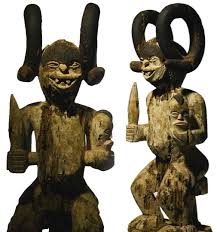
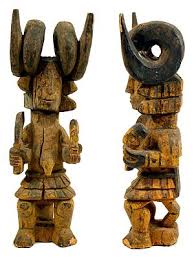
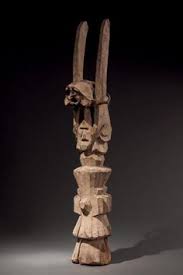
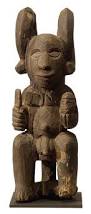
The ikenga is typically depicted as a seated male figure with prominent ram's horns — the ram being associated in Igbo culture with strength, courage, and the capacity to overcome obstacles. The figure often holds a sword (the instrument of achievement through struggle) and a trophy head (the evidence of achievement realised). The iconography encodes the philosophy: achievement requires strength, requires willingness to struggle, and is evidenced by concrete results.
The Ikenga in Practice
Every Igbo man of standing — one who has achieved recognition in his community, who has taken titles, who has built wealth through his own effort — maintains an ikenga in his obi (reception hall). The ikenga is personal: it belongs specifically to its owner and embodies specifically that owner's achievements and aspirations. It is fed with palm wine and kola nut at significant moments: before important commercial decisions, after business successes, before title-taking ceremonies, when seeking guidance in difficulty.
The relationship between a man and his ikenga is one of the most intimate in Igbo religious life — more intimate, in some ways, than the relationship with community deities, because the ikenga is specifically his. It is created for him, dedicated to him, and empowered by his own achievements. A man who neglects his ikenga — who fails to feed it, who fails to acknowledge it — is believed to invite the diminishment of his own power and achievement.
The Philosophy of Personal Achievement
The ikenga embodies one of the most distinctive features of Igbo ethical philosophy: the valorisation of personal achievement through one's own effort. The Igbo proverb Onye wetara oji wetara ndụ — "he who brings kola brings life" — applies to the man who has made something of himself through his own industry. The ikenga tradition insists that each person is responsible for their own success: your father's ikenga cannot make you succeed; you must establish your own and fill it with your own achievements.
This philosophy has deep consequences for Igbo social values. It explains the Igbo emphasis on education as a route to achievement: if success depends on one's own efforts, then investing in one's own capacity for effort — through education, through skill development, through building commercial networks — is the most rational strategy. It explains the Igbo commercial dynamism: a culture that valorises personal achievement through effort will produce energetic entrepreneurship. And it explains the Igbo resistance to arbitrary authority: if achievement is earned rather than inherited, then those who claim authority without earning it are making a false claim that the ikenga tradition implicitly challenges.
Ikenga and Christianity
The missionary attack on the ikenga tradition was particularly direct — ikenga were among the objects most frequently confiscated and burned by Christian evangelists in the colonial period, presented as idols that must be destroyed before a convert could be considered genuinely Christian. Many Igbo families converted to Christianity and destroyed their ikenga as part of that conversion. The loss of these objects represented not only material loss but the severing of a connection to a specific philosophical and spiritual tradition.
Contemporary Igbo scholars and cultural advocates have argued for the recovery of the ikenga tradition — not necessarily as a replacement for Christianity but as a philosophical tradition whose insights about personal achievement, right conduct, and human potential are valuable independent of any specific religious framework. The ikenga's insight that each person is responsible for their own success, that achievement is earned rather than given, and that the divine assists those who assist themselves — these are philosophical positions that deserve to stand on their own terms.