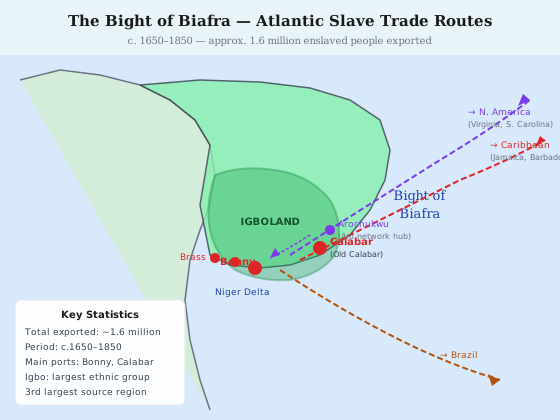
The Igbo Landing of 1803 — the mass act of defiance in which a group of newly arrived enslaved Igbo people chose death over enslavement, walking into Dunbar Creek on St Simons Island, Georgia, singing in Igbo. It is the most celebrated act of resistance in the history of the Atlantic slave trade.
What Happened
In May 1803, the slave ship York arrived off the coast of Georgia carrying a cargo of enslaved Igbo people purchased at the Bight of Biafra. Before the ship could deliver its human cargo to the plantation owners who had purchased them, the enslaved Igbo rose up. They overpowered the crew — killing two of the slavers in the process — and seized control of the vessel. Rather than attempt a return to Africa across thousands of miles of ocean in an unfamiliar ship, they chose a different form of resistance.
The Igbo were landed at Dunbar Creek on St Simons Island. What happened next is documented in multiple contemporary accounts and in the oral traditions of the Gullah Geechee people — the descendants of enslaved Africans on the Georgia and South Carolina coasts who have maintained their African cultural heritage across two centuries. Led by their Eze (king or leader), the Igbo waded into Dunbar Creek singing. They walked into the water, chanting in Igbo. They drowned rather than submit to enslavement.
The number of people involved varies across accounts: estimates range from 10 to over 100. What all accounts agree on is the act itself — the collective, deliberate choice of death over slavery — and the singing. The Gullah oral tradition preserves the words they sang: "The water spirit brought us, the water spirit will take us home."
The Historical Documentation
The Igbo Landing is documented in contemporary plantation records, in newspaper accounts from 1803, and most importantly in the oral traditions of the Gullah Geechee people. The Roswell King plantation records — Roswell King managed the Pierce Butler plantation on St Simons Island — contain references to the incident. Federal Writers Project interviews conducted in the 1930s recorded testimonies from elderly Gullah people whose grandparents had witnessed or heard direct accounts of the event.
The most important documentary source is the testimony of Katie Brown, a Gullah woman interviewed in the 1930s, whose great-great-grandmother was present at Dunbar Creek. Her account — preserved in the Georgia Writers Project collection "Drums and Shadows" (1940) — describes the Igbo walking into the water singing, led by their chief, while the overseers watched from the bank unable to intervene. "They say dem Igbo people, dey don come here and dey ain goin stay," she recalled. The testimony connects the written historical record to living community memory across 130 years.
Why It Matters
The Igbo Landing is significant for several reasons that extend beyond the event itself. It demonstrates the persistence of Igbo identity under the extreme conditions of enslavement: the people who walked into Dunbar Creek identified as Igbo — not as generic Africans, not as enslaved people, not as property — and acted collectively on that identity. Their leader's role in the event suggests that the social structures of Igbo community — the authority of the eze, the capacity for collective decision-making — survived the Middle Passage intact enough to organise collective action within days of arrival.
It demonstrates the specific character of Igbo resistance to enslavement that was documented across the diaspora: the preference for death over submission that slave-owners noted as a distinctive Igbo trait, that appears in the phrase "Ibo can't be made to work" in plantation records, and that produced the warnings in slave-trader manuals against purchasing too many Igbo. The Igbo Landing is the most dramatic and most fully documented expression of this resistance, but it was not unique — similar acts of collective resistance and self-determination are recorded across the diaspora wherever large numbers of Igbo were enslaved.
It is also significant for the Gullah Geechee community, whose preservation of the story across two centuries is itself an act of cultural resistance — the maintenance of memory in the face of a system designed to destroy it. The Gullah Geechee people are the direct cultural heirs of the enslaved Africans of the Georgia and South Carolina coast, and their preservation of African language, foodways, music, and oral tradition makes them one of the most significant repositories of African cultural survival in the Americas.
The Igbo Landing Today
The site of the Igbo Landing at Dunbar Creek, St Simons Island, Georgia, is now a recognised historical landmark. A marker installed by the State of Georgia reads: "Ibo's Landing — Tradition says that a group of Ibo slaves, preferring death to slavery, drowned here." The modest language of the marker — "tradition says," the archaic spelling "Ibo" — reflects the long reluctance of official American history to fully acknowledge what happened. In recent years, particularly since the 2010s, the site has become a significant destination for African American heritage tourism, for genealogical researchers seeking to connect to their Igbo ancestry, and for Igbo diaspora communities who see the Landing as a founding act of Igbo resistance in America.
The Igbo Landing has entered African American cultural consciousness through poetry, song, fiction, and academic scholarship. Toni Morrison's novel Song of Solomon engages with the theme of Africans who could fly — a related tradition from the Georgia Sea Islands. Paule Marshall's Praisesong for the Widow directly addresses the Igbo Landing tradition. The site appears in the work of multiple African American poets and artists who have made it a symbol of the refusal to accept dehumanisation — a refusal that connects the 1803 event to the continuous struggle for Black dignity and freedom.
Connecting Back to Igboland
The DNA testing revolution of the 21st century has given the Igbo Landing a new dimension: the ability for African Americans to discover specific Igbo ancestry and to connect that ancestry to specific communities in Igboland. The Gullah Geechee community has particularly high rates of West African ancestry from the Bight of Biafra region, consistent with the heavy Igbo presence in the enslaved population of the Georgia and South Carolina coast. Heritage tours from the United States to Igboland — visiting Arochukwu (the centre of the Aro trading network that supplied the slave ports), the port of Calabar, and communities with strong oral traditions of involvement in the trade — have created new connections between the diaspora and the homeland that the Atlantic slave trade spent two centuries trying to sever permanently.