
Igbo resistance in the Caribbean — the documented pattern of Igbo-descended enslaved people leading and participating in resistance to slavery across Jamaica, Barbados, Trinidad, and the wider Caribbean.
The Igbo in the Caribbean
The Caribbean received a substantial proportion of the enslaved people transported from the Bight of Biafra. Jamaica, Barbados, Trinidad, Cuba, and the smaller Caribbean islands all have documented Igbo populations among their enslaved African ancestors. The Slave Voyages database records hundreds of ships carrying people from the Bight of Biafra to Caribbean destinations between 1650 and 1850. The names "Ibo," "Eboe," and "Ebo" appear in Caribbean plantation records throughout this period, identifying individuals as being from the Igbo-speaking region.
The specific character of Igbo presence in the Caribbean is documented not only in the numbers but in the contemporary accounts that singled out Igbo-descended enslaved people for specific attributes. Planters' manuals, travellers' accounts, and plantation records consistently describe "Ibos" as proud, resistant, prone to running away, and likely to choose death over submission. These accounts, while written from the perspective of enslavers and carrying the biases of that perspective, are consistent with the documented pattern of Igbo resistance across multiple Caribbean contexts.
The Igbo Landing and Its Caribbean Echoes
The most famous act of Igbo collective resistance in the Americas occurred not in the Caribbean but on the coast of Georgia — the Igbo Landing of May 1803, when a group of newly arrived Igbo enslaved people walked into Dunbar Creek singing rather than submit to enslavement. But the pattern of collective suicide as resistance — encoded in the Igbo cultural tradition and documented across multiple sites in the Atlantic diaspora — appeared in the Caribbean as well. The "flying Africans" tradition of Caribbean oral culture — stories of enslaved Africans who flew back to Africa rather than submit to slavery — has a specifically Igbo dimension in several Caribbean communities.
Bussa and the 1816 Barbados Revolt
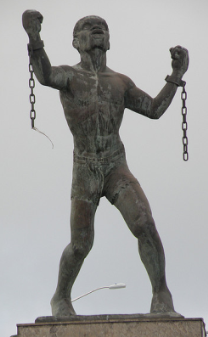
The most significant individual act of Igbo-linked resistance in the Caribbean was the Easter Rebellion of 1816 in Barbados, led by Bussa — a man whose African origins are documented as being from the Bight of Biafra region, consistent with Igbo origin. Bussa led an uprising of approximately 5,000 enslaved people — the largest revolt in Barbadian history — on Easter Sunday 1816. The rebellion was suppressed within days by British regular troops; Bussa was killed in battle; more than 200 enslaved people were subsequently executed and 70 deported.
Bussa is now the national hero of Barbados. His statue — the Emancipation Statue in Bridgetown, erected in 1985 — shows him with arms raised and chains broken. The specific Igbo dimension of his heritage is acknowledged in Barbadian historical scholarship and connects the Barbadian emancipation tradition to the broader story of Igbo resistance across the Atlantic world.
Jamaica: The Maroons and Igbo Resistance
Jamaica has one of the most complex histories of African resistance to slavery in the Caribbean, including the Maroon communities of the interior — communities of escaped enslaved people who maintained independence in the Jamaican mountains and negotiated formal treaties with the British colonial government in 1739 and 1740. The Igbo presence in Jamaican slave resistance is documented in multiple contexts: in the records of individual runaways identified as "Ibo" in Jamaican newspapers, in plantation records noting the particular resistance of Igbo-identified enslaved people, and in the oral traditions of Jamaican communities that identify Igbo ancestry.
The Tacky's War of 1760 — the most significant slave uprising in Jamaica before emancipation — had significant involvement from enslaved people identified as "Coromantee" (Akan) but also drew on resistance networks that included Igbo-descended participants. The pattern of cross-ethnic solidarity in Jamaican slave resistance — the formation of resistance networks that crossed the ethnic divisions that enslavers deliberately fostered — is itself part of the Igbo diaspora story in the Caribbean.
Trinidad and the 19th Century
Trinidad received significant numbers of enslaved people from the Bight of Biafra in the late 18th and early 19th centuries, particularly after the island came under British control in 1797. The Igbo presence in Trinidad is documented in plantation records and in the oral traditions of specific Trinidadian communities. The post-emancipation period brought a different kind of Igbo connection to Trinidad: a small number of "Liberated Africans" — people freed from slave ships by the Royal Navy — were settled in Trinidad, and some of these were from the Bight of Biafra.
Contemporary Trinidadian communities maintain some awareness of Igbo ancestry, though the specific cultural markers that would identify a community as distinctly Igbo have largely been absorbed into the broader Afro-Trinidadian cultural synthesis. The recovery of Igbo-specific ancestry in the Caribbean — through oral tradition, archival research, and increasingly through DNA analysis — is an ongoing project connecting contemporary Caribbean communities to their specific West African origins.
The Pattern of Resistance
Across the Caribbean, the documented pattern of Igbo-descended enslaved people is consistent: high rates of running away, high rates of participation in organised resistance, and a specific cultural pride — documented in contemporary accounts by enslavers who found "Ibos" difficult to control — that made submission to slavery particularly painful. This pattern is not coincidental. It reflects the Igbo cultural formation that shaped the people who were transported: the emphasis on personal achievement and dignity, the tradition of resistance to illegitimate authority expressed through the Ekumeku and later the Women's War, and the specific psychological character of people from a culture that valued individual worth over submission to hierarchy.