
The trans-Saharan slave trade and the Igbo — the Arab-run trade routes that carried enslaved West Africans northward across the Sahara for over a millennium, and the Igbo presence in North Africa and the Arab world.
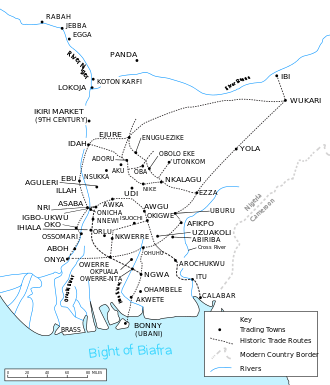
The Trans-Saharan Trade
The Atlantic slave trade — which carried approximately 1.6 million people from the Bight of Biafra to the Americas — is the most documented and most discussed of the forced migration systems that affected the Igbo. But it was not the only one. The trans-Saharan slave trade — which carried enslaved West Africans northward across the Sahara to North Africa, Egypt, and the Arab world — preceded the Atlantic trade by centuries, overlapped with it for nearly four hundred years, and continued after the nominal abolition of the Atlantic trade in the 19th century.
The trans-Saharan trade is estimated to have carried approximately 7 to 10 million enslaved Africans across the Sahara over a period of roughly 1,300 years — from the 7th century CE, when Arab conquest of North Africa created the demand, to the early 20th century, when colonial administrations finally suppressed the trade across most of the Saharan region. The majority of the people transported were from West and East Africa; the proportion that was specifically Igbo is not well documented, but given the Igbo's prominence as a source of enslaved people and the Bight of Biafra's role as a major slave-trading region, Igbo people were certainly among those transported northward.
The Arab Role in West African Slavery
The Arab role in West African slavery is a subject that requires careful historical treatment. Arab merchants did not create West African slavery — slavery existed in West African societies before Arab contact, as part of the social and economic systems of the region. What the trans-Saharan trade did was dramatically increase the external demand for enslaved people, creating commercial incentives for the capture and sale of Africans that intensified internal conflicts and destabilised communities across the Sahel and West African forest zone.
The trans-Saharan trade also had a specifically gendered character that differed from the Atlantic trade. The Atlantic trade transported roughly equal numbers of men and women (with a slight male majority), because the primary demand was for agricultural labour in the plantation economies of the Americas. The trans-Saharan trade had a higher proportion of women and children, because the primary demands in the Arab world were for domestic servants, concubines, and eunuchs rather than for agricultural field labour. This difference in the structure of demand produced different patterns of transport, sale, and use.
Igbo in the Arab World
The documentation of specific Igbo individuals in the Arab world — in North Africa, Egypt, the Arabian Peninsula, and further east — is sparse and difficult to recover. Unlike the Atlantic diaspora, where enslaved Africans' origins were sometimes recorded in ship manifests and plantation records, the trans-Saharan trade left fewer systematic documentary records. What we know comes primarily from Arabic travel and geographical literature — writers like Ibn Battuta and Al-Idrisi who described West African peoples and places — and from the occasional reference in Arab administrative records.
Contemporary genetic studies of North African and Middle Eastern populations have found evidence of sub-Saharan African genetic ancestry consistent with the historical trans-Saharan slave trade. Some of this ancestry is from regions consistent with Igbo origin — the Bight of Biafra and southeastern Nigeria. The recovery of the trans-Saharan dimension of Igbo diaspora history is an ongoing project that requires collaboration between historians, linguists, geneticists, and Arabic-language scholars.
The Kola Nut and Arab Trade
The most significant commodity connection between Igboland and the Arab world was not enslaved people but kola nuts. Kola nuts — stimulants that contain caffeine and related compounds — were a major trade commodity on the trans-Saharan routes, carried northward from the West African forest zone to the Muslim communities of the Sahel and North Africa, where they were valued as a non-alcoholic stimulant compatible with Islamic prohibition on alcohol. The Igbo were major producers of kola nuts, and the kola trade connected Igboland to the broader Islamic world of the Sahara and North Africa long before any direct Arab contact with southeastern Nigeria.